AI LinkedIn Post Generator, Carousel Maker & Analytics Tool

Are LinkedIn impressions just vanity metrics, or do they actually signal growth?
It’s a question I see asked a lot. The truth? Impressions matter, but not in the way most people think.
High impression counts look good on paper. But without context, they don’t tell you much about what’s actually working.
This guide breaks down what LinkedIn impressions really are, how they work, and how to use them to grow your presence on the platform.
What Are LinkedIn Impressions?
LinkedIn impressions measure how many times your content appears on someone’s screen.
Every time your post, article, or update shows up in someone’s feed, that’s one impression. If someone scrolls past your post, refreshes their feed, and sees it again, that counts as another impression.
Here’s what impressions don’t tell you: whether someone stopped to read your post, whether they liked it, or whether they clicked through to your profile. An impression simply means your content was displayed.
Think of it this way: impressions measure visibility, not engagement.
Impressions vs Reach vs Engagement
These three metrics often get confused, but they measure different things:
Impressions = Total number of times your content was displayed (including multiple views by the same person)
Reach = Number of unique people who saw your content (each person counted once)
Engagement = Actions taken on your content (likes, comments, shares, clicks)
Here’s why this matters: impressions come first in the visibility chain. Without impressions, you can’t get reach. Without reach, you can’t get engagement. But impressions alone don’t create relationships or opportunities. They’re the starting point, not the end goal.
Do LinkedIn Impressions Matter?
Yes, but with context.
Impressions are useful when you’re building brand awareness or testing content. They show you whether your posts are getting distribution. If your impressions suddenly drop, that’s a signal that something has changed with your content or LinkedIn’s algorithm.
But impressions can also mislead you. A post with 10,000 impressions and 5 comments isn’t performing as well as a post with 1,000 impressions and 50 comments. The second post sparked conversation. The first one didn’t.
Use impressions to measure visibility and distribution. Don’t use them as your only success metric.
How LinkedIn Impressions Work
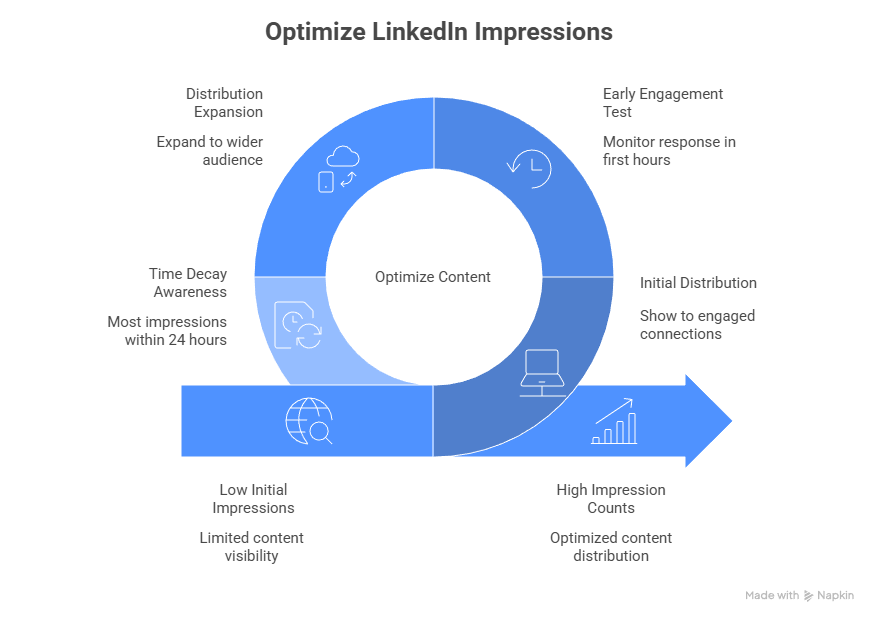
LinkedIn doesn’t show your content to everyone at once. The platform uses an algorithm to test and distribute your posts in stages.
-
- Initial distribution: When you publish a post, LinkedIn shows it to a small group first. This usually includes your most engaged connections and people who’ve interacted with similar content recently.
-
- Early engagement test: LinkedIn watches how that initial group responds in the first 1-2 hours. High engagement signals quality content to the algorithm.
-
- Distribution expansion: If your post performs well in the test phase, LinkedIn expands distribution to a wider audience. This can include second-degree connections and users following relevant hashtags.
-
- Time decay: Most posts receive 70-80% of their total impressions within the first 24 hours. After 48 hours, impression rates drop significantly unless the post goes viral.
Understanding this process helps you optimize for better distribution and higher impression counts.
Types of LinkedIn Impressions
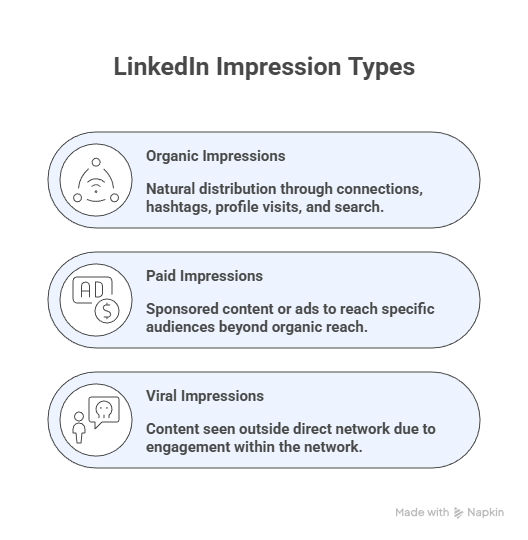
LinkedIn breaks down impressions into three categories:
-
- Organic impressions come from natural distribution. Your connections see your posts in their feeds, or people discover your content through hashtags, profile visits, or LinkedIn search.
-
- Paid impressions result from sponsored content or ads. You pay to show your content to specific audiences beyond your organic reach.
-
- Viral impressions happen when people outside your direct network see your content because someone in their network engaged with it. High engagement rates drive viral distribution.
Most successful LinkedIn strategies combine organic and paid impressions. Organic builds credibility over time. Paid accelerates the reach for specific goals.
What Influences LinkedIn Impressions
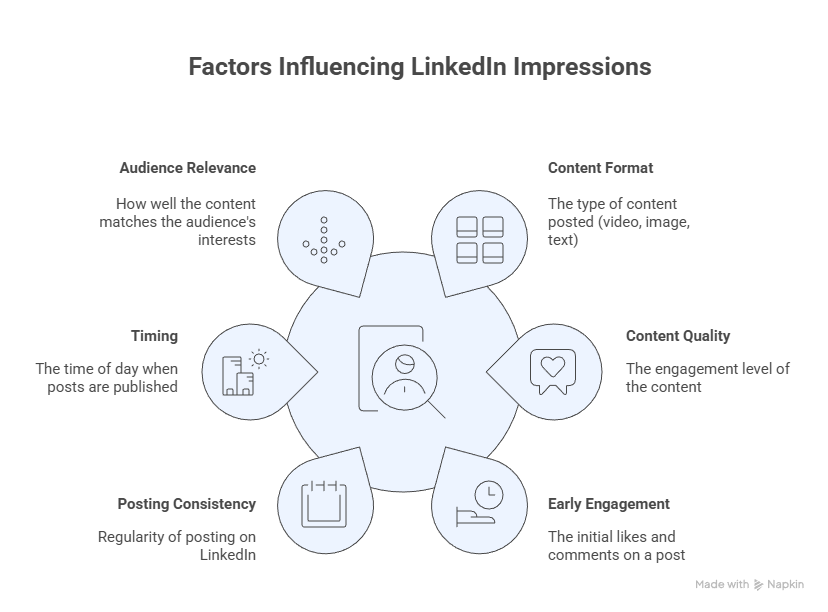
Several factors determine how many impressions your content receives:
Content format: Video and image posts typically get more impressions than text-only posts. LinkedIn prioritizes visual content to keep users on the platform longer.
Content quality: Posts that generate quick engagement get expanded distribution. The algorithm rewards content that sparks conversation.
Early engagement: The first hour matters most. Posts that get likes and comments quickly signal quality to LinkedIn and receive broader distribution.
Posting consistency: Regular posting trains the algorithm to prioritize your content. Accounts that post daily see higher impression rates than those posting sporadically.
Timing: Posting when your audience is active increases the chances of early engagement, which triggers wider distribution.
Audience relevance: Content that resonates with your specific audience performs better. Generic posts rarely generate high impressions.
How to Get More LinkedIn Impressions
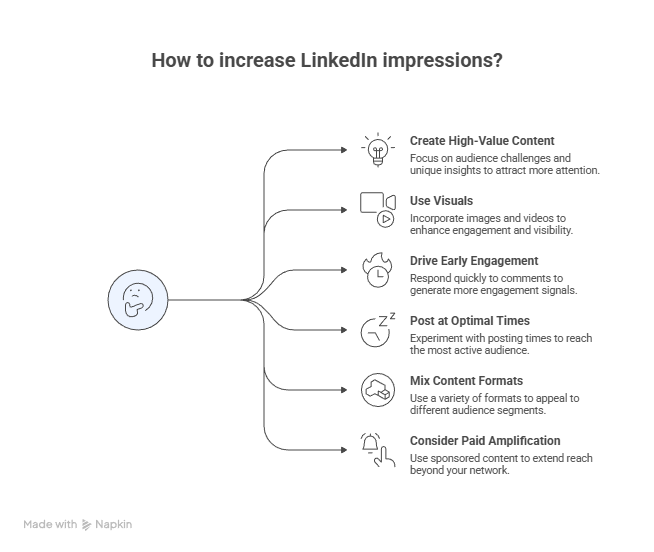
Here are six practical strategies to boost your impression rates:
Create relevant, high-value content. Focus on your audience’s challenges and interests. Share insights they can’t easily find elsewhere. Practical, actionable content consistently outperforms generic advice.
Use visuals and native formats. Posts with images, carousels, or videos get more visibility than text-only content. Upload media directly to LinkedIn rather than linking to external sites.
Drive early engagement. Respond to comments quickly after posting. Each response generates additional engagement signals and brings commenters back to your post.
Post at optimal times. Test different posting times to find when your audience is most active. For most professionals, weekday mornings and early afternoons perform best.
Mix content formats. Alternate between videos, images, text posts, and polls. Different formats appeal to different audience segments and keep your feed from becoming predictable.
Consider paid amplification. For important announcements or high-performing posts, sponsored content can extend your reach to targeted audiences beyond your network.
How to Measure LinkedIn Impressions
You have two main options for tracking impressions:
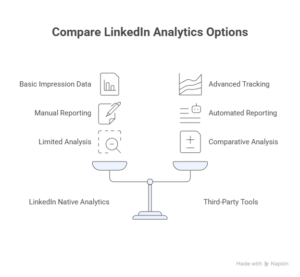
LinkedIn native analytics provide basic impression data for each post. Click the three dots on any post and select “View post analytics” to see impressions, engagement, and demographic breakdowns.
Third-party tools offer advanced tracking, automated reporting, and comparative analysis. Tools like Supergrow provide detailed insights into which content types and posting strategies generate the highest impression rates for your specific audience.
For professionals managing multiple accounts or clients, third-party analytics save time and provide deeper strategic insights than LinkedIn’s built-in tools.
Common Misconceptions About Impressions
High impressions don’t automatically mean success. A post can rack up thousands of impressions but generate zero meaningful conversations or opportunities.
Low impressions don’t mean bad content. A post with 500 impressions and strong engagement from the right people often delivers better results than a post with 5,000 impressions and weak engagement.
Impressions don’t equal real outcomes. The goal isn’t just visibility. It’s relationships, opportunities, and growth. Impressions are a step toward those outcomes, not the outcome itself.
The Real Metric That Matters More Than Impressions
Engagement quality beats impression quantity every time.
A handful of thoughtful comments from potential clients, partners, or employers matters more than hundreds of passive views. Real conversations create real opportunities.
Focus on building relationships through your content, not just broadcasting messages. Ask questions. Respond to comments. Engage with other people’s posts. These actions compound over time and create momentum that impressions alone can’t generate.
The most successful LinkedIn users understand this: visibility creates opportunity, but relationships create results.
Final Thoughts
Impressions are important, but they’re just one part of a bigger picture.
Use them to measure visibility and test what’s working. But don’t optimize for impressions at the expense of engagement, relationships, and real business outcomes.
The best approach? Create valuable content consistently, engage authentically with your network, and pay attention to what resonates. Impressions will follow naturally when you focus on serving your audience well.